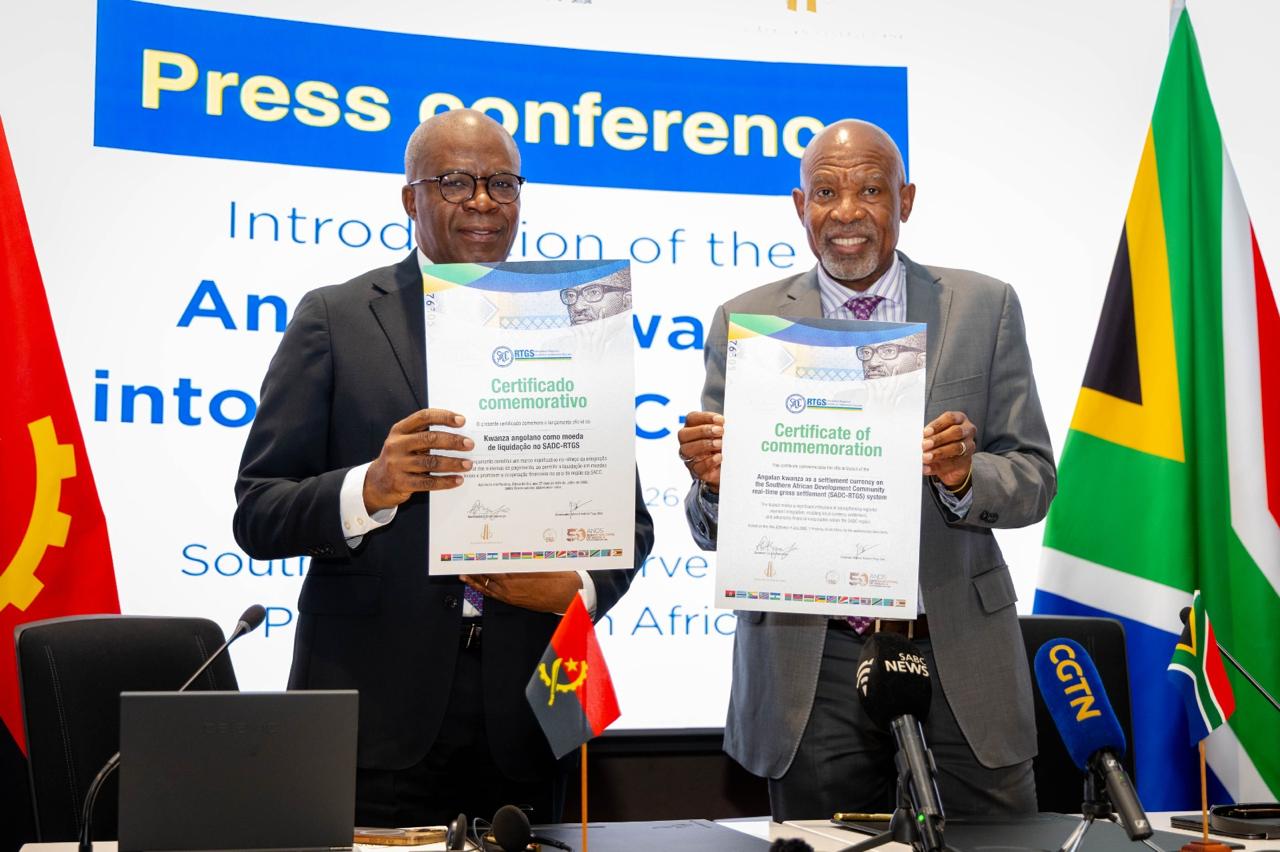
In line with efforts to boost Southern African Development Community (SADC) trade and financial integration, Lesetja Kganyago, Governor of the South African Reserve Bank and Chairperson of the SADC Committee of Central Bank Governors (CCBG), and Manuel Tiago Dias, Governor of the Banco Nacional de Angola, on 27 July 2026 formally announced the introduction of the Angolan kwanza as a settlement currency in the SADC real-time gross settlement (SADC-RTGS) system.
The kwanza’s inclusion supports regional payments modernisation efforts and aligns with the Group of Twenty’s (G20) cross-border payment goals of reducing costs, increasing speed and improving efficiency in cross-border transactions.
The Angolan kwanza is the second settlement currency to be introduced in the SADC-RTGS system, which has settled transactions exclusively in South African rand since its inception in 2013. There are currently 15 countries participating in the SADC-RTGS system.
By enabling direct settlement in kwanza, participants transacting in the currency can reduce foreign exchange conversion requirements, helping to lower transaction costs for participants and their customers. The intention is to onboard additional regional currencies, such as the Botswana pula, in due course.
The enablement of a multi-currency capability in the SADC-RTGS system is one of the strategic initiatives to strengthen regional financial integration, promote greater use of local and regional currencies in cross-border trade and reduce reliance on non-SADC currencies.
A more diverse set of settlement currencies in the system makes it easier for businesses and customers to transact across SADC countries in local currencies. Faster settlement can also help businesses manage cash flow more efficiently and access funds more quickly when trading across the region.
About the SADC-RTGS
The SADC-RTGS system, which marked 13 years of operation on 13 July 2026, processes R250.7 billion worth of transactions per month. It is operated by the South African Reserve Bank, as appointed by the SADC Committee of Central Banks Governors.
In 2025, trade and interbank transactions between Angola and the other 14 SADC states amounted to approximately US$3.77 billion across nine currencies. South Africa accounted for a significant share of these flows, at nearly US$2.99 billion, representing about 60% of transaction volumes and 79% of total value.
The SADC-RTGS system supports economic growth by enabling a more connected regional payments system, reducing friction in economic activity and helping to create an environment that is conducive to trade, investment and job creation.
Payments are safer and more secure because transactions are settled through central banks. There is also a reduction in the delays and risks associated with using multiple banks and foreign intermediaries to process payments.
By joining the SADC-RTGS system, a country can enable its currency to play a greater role in regional trade and finance, reduce reliance on foreign currencies and intermediaries, lower the cost of doing business across borders and strengthen its position within the evolving Southern African and African financial landscape.


